On Sunday, June 14th I participated in the Air Force Association Cycling Classic. The Classic isn't a race or Grand Fondo, rather, it's a hybrid ride where awards are given for completing a certain number of laps within a three hour period. Each lap is 15K (9.4 miles) and includes one small hill (a 100', 3-6% grade up and around the Air Force memorial). The rest of the course is flat on wide roadways closed to traffic.
This is a well attended, well-run event. Every rider should do this at least once!
Course map
I've been wanting to ride this for a while and this year the timing worked out.
Crystal City is one of the early semi-planned urban centers that sprouted around DC in the mid 1970s as the size and scope of government grew. Many of the features of Crystal City (such as underground tunnel-ways lined with stores and restaurants) were unique at the time. But the Jetsons-antiseptic-sameness has gone out of style (thankfully) since the urban planner glory days of the 60s and 70s.
Crystal City was for work. For anything else you went elsewhere.
That's changing, though, as various higher-end chain restaurants lease space and add some options (McCormick & Schmicks, Legal Seafood, Ted's Montana Grill, Cosi, Sunbway, and others). There's not much shopping to speak of, and most sidewalks originally designed as utilitarian pathways remain fairly sterile.
I'm not sure if there's a link between the Air Force Challenge ride and Crystal City, but it must help weekend hotel occupancy and restaurant traffic quite a bit. We stayed at the official event hotel (the decent Crystal City Marriott at Reagan National Airport), and it was very busy.
I've been following Horner in the various cycling news sources since he won the Lancaster pro race in '96. He seemed to win every US race in the 90s and I was surprised when he didn't immediately dominate the Euro scene. Horner participated in eight editions of the Tour de France and won the 2013 Tour of Spain. I read his book (Reading the Race) and wished I had it when I was racing!
He was gracious and stood up to shake hands (which means something in these clueless days of first name familiarity). It's always hard to know what to say -- do I bore him with a recitation of all his accomplishments? Thank him for being a really fast guy despite advanced years? What?
So we just said hello, asked how the trip was going, and whether he was OK riding in the humid Virginia heat. He said he loved riding in the heat and preferred not to ride in the rain. His team was ready to roll so we didn't detain him anymore.
This is a well attended, well-run event. Every rider should do this at least once!
Course map
I've been wanting to ride this for a while and this year the timing worked out.
The Venue
I've been to Crystal City, VA many times for work, but never for a pleasure trip. It was a bit odd to check in to the hotel and realize, "I don't have any meetings tomorrow..."Crystal City is one of the early semi-planned urban centers that sprouted around DC in the mid 1970s as the size and scope of government grew. Many of the features of Crystal City (such as underground tunnel-ways lined with stores and restaurants) were unique at the time. But the Jetsons-antiseptic-sameness has gone out of style (thankfully) since the urban planner glory days of the 60s and 70s.
Crystal City was for work. For anything else you went elsewhere.
That's changing, though, as various higher-end chain restaurants lease space and add some options (McCormick & Schmicks, Legal Seafood, Ted's Montana Grill, Cosi, Sunbway, and others). There's not much shopping to speak of, and most sidewalks originally designed as utilitarian pathways remain fairly sterile.
Crystal Drive a boulevard in the European mode with wide sidewalks and small green parks interspersed. Crosswalks and sidewalks along Crystal Drive are brick paved. It helps, and it's obvious the current developers figured out Soviet-style efficiency is no longer appealing (even to government bureaucrats).
I'm not sure if there's a link between the Air Force Challenge ride and Crystal City, but it must help weekend hotel occupancy and restaurant traffic quite a bit. We stayed at the official event hotel (the decent Crystal City Marriott at Reagan National Airport), and it was very busy.
Arrival
We arrived Saturday around 1030. We were earlier than expected but the clerk was gracious and checked us in early. We unloaded the car, then rode the Metro to Clarendon for registration packet pickup (I'm glad we did -- the line Sunday morning looked like Hershey Park roller coaster in July). On the way out of the hotel I saw a bunch of guys in Airgas kit and recognized Chris Horner.I've been following Horner in the various cycling news sources since he won the Lancaster pro race in '96. He seemed to win every US race in the 90s and I was surprised when he didn't immediately dominate the Euro scene. Horner participated in eight editions of the Tour de France and won the 2013 Tour of Spain. I read his book (Reading the Race) and wished I had it when I was racing!
He was gracious and stood up to shake hands (which means something in these clueless days of first name familiarity). It's always hard to know what to say -- do I bore him with a recitation of all his accomplishments? Thank him for being a really fast guy despite advanced years? What?
So we just said hello, asked how the trip was going, and whether he was OK riding in the humid Virginia heat. He said he loved riding in the heat and preferred not to ride in the rain. His team was ready to roll so we didn't detain him anymore.
The Clarendon Cup
We took the quick metro to Clarendon and then walked out of the station into the middle of a bike race. The Clarendon Cup criterium men's pro race had just started and we were able to watch a few laps. The speed of a men's pro race is truly amazing and impreessive at a live race with the sound of wheels and bodies and bicycles flying by at 30 MPH just a few feet away. While I'm grateful for television coverage of races, cycling isn't a great TV sport. This sport requires proximity.

Cycling is no different from other sports -- you enjoy and appreciate it more if you have suffered a few times in competition. I raced for a couple of years in the early 90s and found the speed exhilarating.

Cycling is no different from other sports -- you enjoy and appreciate it more if you have suffered a few times in competition. I raced for a couple of years in the early 90s and found the speed exhilarating.
Winning wasn't a big driver for me (I did OK), but I mostly enjoyed training and racing at high speed in a pack. The miles flew by and hills were barely noticeable. After a few rides you learn who's who and adjust accordingly. In a really good group you are inches apart, and everyone knows to pull for just a few pedal stokes and then drift back on the windward side. It's efficient, effective, and so different from solitary riding that you have to do it a lot before you are good enough to enjoy it. So you have to work hard, listen, learn, and maintain humility until you are strong enough to be an equal participant.
The downside is that this takes time (3-4 hours a day, 3-5 times a week), and a set time (try getting ten Type A people together for a meeting). In large cities with an established cycling culture, this isn't too difficult. But in less densely populated areas it can be a challenge.

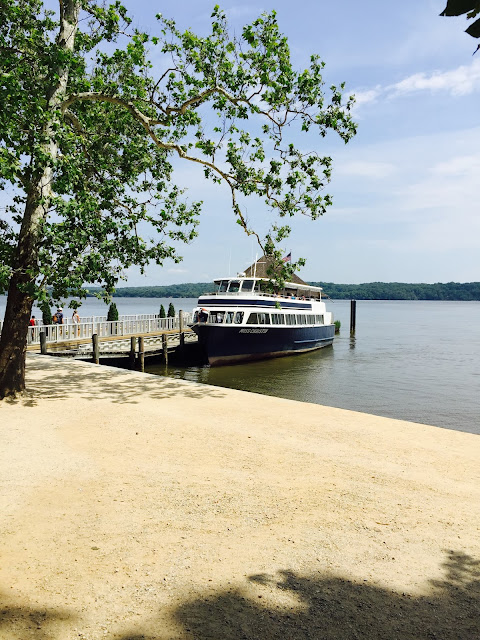
After the cruise we walked up to the mansion. The view from the veranda is beautiful, and I can only hope General Washington had time to enjoy it. The mansion is surrounded by various outbuildings -- Mount Vernon in Washington's time was a small town of several hundred people over 8,000 acres. Alas we had minimal time, as the grounds closed at 5.
We drove back to Crystal City and decided to just walk to a restaurant close to our hotel (We'd planned to metro into DC but we were both wiped out from the drive, all the walking, and the heat). Ted's Montana grill seemed like a good choice and so we both enjoyed a decent burger and baked potato. I never quite figured out what the best pre-race meal should be (pasta doesn't work for me), but I try to avoid fiber-filled, heavy, greasy, or spicy foods. Ted's was fine and we were both satisfied with the meal. The dessert list had no cake -- what?! So we left Ted's checked out the hotel restaurant (BELL20), and found they had specialty cupcakes on the menu.
I'm spoiled when it comes to desserts -- Janet has mastered baking and we eat well (too well). No boxed mixes for us! So often restaurant dessert is over-processed, over-priced, and disappointing.
We were pleasantly surprised with the cupcakes at BELL20 Restaurant - they were moist, not overly sweet, and fresh. The presentation was nice and we enjoyed our dessert (chocolate for Janet and lemon for me).
I'm a pretty good planner and packer (Army training) but I always feel like I forget something really important. That feeling only goes away after I've started whatever. This morning was no different and I carried that nagging worry until I clipped in and started riding out of the parking garage. I met Janet outside and she had my extra water bottles and Gu packets ready for later (good thing -- it was hot and I went through four bottles in 3 hours and still was still somewhat dehydrated). I told her I would see her once every half hour as I rode each lap. She told me she'd be around the same spot in case I needed water or gels.
I'm amazed how many of my obsessions Janet has cheerfully endured over the years -- from bicycle racing to motorcycles to flying to hunting, backpacking, and canoeing -- when I do stuff, it tends to be all out (so when we canoe, we don't float ten miles and camp -- we wilderness canoe and paddle 30 miles a day). This can be exhausting (especially for the people NOT so into paddling 30 miles a day) but somehow she's put up with me for 34 years. I have to remind myself to be grateful -- I never "ask permission" and never hear "You'd better not!" Janet has been a patient, loving, helper and having her by my side has made everything far more fun, meaningful, and bearable.
She's not a great coach, though. Years ago we were visiting her parents in a remote, very hilly part of West Virginia. I asked her to drive behind me as I went for a ride in the mountains (this was before cell phone towers were ubiquitous). It was remote, unusually hot, and unbelievably hard riding. I would fly down the backside of one hill and then crawl up the next. Every uphill included a swarm of biting deer and horseflies who were undeterred by the 8 MPH wind I was creating.
After an hour of this Janet rode up beside me, rolled down the window and yelled, "Are you OK? You look tired and hot.... you sure you want to keep going?"
Of course these same thoughts had been going through my mind up every climb, but part of training is learning how to impose your will on a reluctant body.
I looked at her and said in between gasps, "Of course I want to keep going..."
She just gave me the "This is dumb" look and fell back in behind me.
She's perfect.
A fellow rider was messing with the timing chip so I asked him how to mount the MyLaps device (it doesn't matter -- as long as the device is on your frame it will register). I dutifully placed it along the front of the handlebar mount using twist ties. It messed up my Looking Fabulous At All Times roadie appearance, but it was mostly hidden by the Garmin bar mount.
Crystal Drive was free of traffic and I enjoyed riding up and down the wide roadway. But it was quickly filling up with a large riders.
The majority were roadies of varying levels of commitment (ranging from $2,200 Zipp 404 wheelsets and matching Rudy sunglasses to $400 Treks, from mountain bike shoes or sneakers to Giro SLK Empires, from gym shorts to full team kit).
The color swath was impressive, with blue dominant but only one Giro d'Italia maglia rosa. There were a few rainbow stripes and national champion jerseys on unlikely bearers, but who knows? (Later I passed quite a few casual bike path cyclists, beach cruisers, recumbent riders, tandem teams, hand cyclers, and even one guy on a rolling elliptical trainer).
The triathletes were out in force with the requisite twin bottles sticking out from the hinder end of the saddle, frames with "Slice" and Dagger" decals on the side, aero bars, sleeveless tank tops, and killer shades. Of course they were fabulously fit -- but could they ride in a straight line?
The herd was getting restless and started moving into place in the giant Crystal Drive cattle chute. I was surprised, even awed by the throng -- the net value of the carbon fiber alone dwarfed the GDP of Ireland.
I found a spot along the cattle chute walls and prepared for the start. I had decent, safe spacing around me for starting off, but soon learned that people in DC see "open space" as "place to shove my Felt Tri Bike and/or Mercedes S Class." So I had to move over a bit to prevent the inevitable slithering on awkward road shoes by riders unfamiliar with space, clip in shoes, and etiquette.
One particularly awkward but intrepid soul slid by me to gain four feet and then sat behind the same wall of derrieres the had been blocking the rest of us. I noticed his Louis Garneau European Posterior Man Satchel (EPMS) dangling 6" below the seat rails.
We waited.
And waited.
Finally the announcer told us there were cars parked along the route that were being towed away.
So we waited some more.
Goodbye warm up, hello crampy-legs.
Since we had time I decided to offer my assistance the the EPMS bearer -- "Can I give you a hand with this?" I asked. He seemed nice and a bit overwhelmed so I showed him how to mount his EPMS properly so it didn't swing like the plastic male bovine equipment dangling under redneck pickups.
We waited some more as various expressions of gratitude and pride were broadcast through over-amped speakers in the concrete canyon. I tried to pay attention but it was difficult
I certainly appreciate all the work the organizers, volunteers, police, security, DOT and other people needed to make an event of this scale happen. I wish there was a better way to express thanks than to sit glumly waiting for the "Go!" signal. But there it is -- and it wasn't that bad.
I did hear the announcer say two things that made many of us grateful:
And then we waited some more...
I herd the blessed sound of pedals being clipped in, and realized it was finally time. I shuffled a bit, clipped in the left foot, and slow pedaled in the midst of a giant moving mass of bodies, carbon fiber, and Lycra.
It took a while for the herd to get sorted out. When I finally clipped in my right shoe I was averaging 10 MPH.
I safely navigated the first turn and then the next, and then up the ramp to Jefferson Davis Highway, a wide three lane path of broad asphalt that nearly demanded afterburners and warp speed.
I went out way too fast but who doesn't? We'd been standing around a long time, I'd been preparing for a couple of weeks, and finally the ride was on. I carefully picked my way through the ever-thinning herd like Dave Stoller chasing down the Italians in Breaking Away.

I was surprised when I reached the turnaround point at Wilson Boulevard -- here already? I motored back to pace speed and then imposed some discipline and found a wheel and sat in for a bit: "Relax -- there are many miles to go and you don't need to be expending all this energy to chase."
There was no way I'd catch the lead group so I decided to ride from wheel to wheel and slowly make my way forward.
The tactic worked until the Air Force Memorial hill, where the group dissolved into a leg-spinning granny gear frenzy. I tried to pick my way around several nearly stopped cyclists but the road surface hid many, many wheel-eating gaps. It was like climbing a hill on a mountain bike -- weight balanced, pick a line, ride the line, pick the next line -- get bumped off the line by other cyclists weaving across the 5% grade -- readjust, repeat.
Oh well -- no time would be made up on this hill.
After safely navigating the obstacle course I turned into the memorial parking lot for the hairpin turn around the flag. Two girls were running a DJ booth pumping out Disco -- it was cool and fun and I smiled and waved. The memorial drive and lot is paved with bricks so we had a small stretch of pave to content with. But since these pave were laid in the latter part of the 20th C., the surface was smooth.
A quick left-hander around the flag and then down we go -- a nice quick descent at 35 MPH and dive into a sweeping right hander. The course flows into another sweeping right and then up a bit to a hairpin left back onto Jefferson Davis Highway. The level, wide road enabled some re-grouping to happen and so I hopped from wheel to wheel back into Crystal City.
Crystal Drive is a tough road -- there are lots of potholes, cracks, uneven pavement, and several brick-paved cross-walks. I tried to pick my way through but it was impossible at speed (When I watched the pros speed by on the same road at noon I realized how tough they and their bikes must be to race that fast over roads that hard for as long as they do).
I saw Janet on the side of the road, waved, and bumped my way down the straight, hit the finish, and counted one lap down -- my Garmin beeped my lap time: 25:13. Good -- well under the required 30 minutes per lap required for gold, and 21 MPH average (an 18.6 average would result in 6 laps in 3 hours).
The next three laps settled down. I found a few good groups to work within and together we maintained a decent pace. But every time we hit the AF memorial hill the group would shatter and it was every man for himself. Some would leave me behind, most would drop back -- no matter, I had no interest in blowing up -- steady power was the game plan, so I maintained between 90 and 100 RPM whether the road was up or down. The lap times remained steady: 26, 26, 27. Still in the 21 MPH range.
This sort of ride (as opposed to a race) is more like day-to-day life: You encounter many people, link up with some for a while, exchange pleasantries with others, and avoid bumping into a few. I enjoyed seeing the wide variety of rider and machine out on the course (once things had settled down and there was enough space to maneuver). I tired to say "This is fun!" and "What a beautiful day!" but most riders were at the limit so most responses were nods or halfhearted grunts. That's OK -- it's easier when it's fun, and we chose to be here, right?
While my heart rate was about 10-15 BPM higher than normal on hard training rides, breathing was not a problem (I attribute this to several days rest before the ride). I was surprised when seat fatigue and shoe hot spots started taking a toll. This course is flat, and the small hill doesn't require standing. I had to force myself to stand every so often on the flat to relieve pressure.
I was starting to feel the heat and on lap 4 both bottles were empty. Fortunately Janet was at the same spot and I pulled over and asked for my other bottles. Both were reasonably cold and full. I'd taken 3 gels already and was starting to get sick of them. Nevertheless I could feel my energy reserves dwindling so I drank 1/2 a bottle and downed another gel while bumping down Crystal Drive.
The fourth lap was a bit more work as I spent lots of time alone. Riders were either very slow or just fast enough to catch, but not fast enough to work with. I'd lost track of any groups I'd been with earlier and the solo time trial coupled with the heat started draining me. I motored through but the fifth lap time showed a long 29 minutes. The lap time was fast enough to finish in time for 6 laps, but I was definitely working too hard for that average speed.
On the last lap my shoes hot spots really bothered me. I've worn these Sidis over two years and never had a problem. But this was the first long ride with the new Giro socks and they were just too thin. I felt like I had a wide blister across the whole of the ball of my left foot. It helped in weird way because the discomfort in my foot diverted my attention from the overall discomfort I was feeling. I was starting to bonk and was pedaling squares. Ugh.
On my way back to Crystal City on Jeff Davis highway I saw the broom wagon making its way eastbound. I was a lap ahead of it, so I settled in to an easy cadence and gear and recovered my way onto Crystal Drive. I rolled across the finish line and made the left to medal distribution where the honor system was definitely in full force. I double checked the Garmin -- yep, 6 laps in 2:50. OK, Gold medal line for me.
I found Janet and she took some pictures and then we headed back to the hotel where I drank 1/2 gallon of water, ate some pretzels, and showered to remove road grime and reduce body core temperature to something less interesting to the ER staff.
(It gets better -- Hilton Clarke won both races)
After watching some racing, we headed to Cosi for lunch (yes, a light sandwich was all I craved). After that, Coldstone Creamery sufficed as the apres-ride sweet. Yum.
I wanted to stick around and watch the racing but we had a long drive back and I wanted some recovery time a la maison. So we packed up, checked out, and headed north, back to steamy Pennsylvania.
Dura Ace drivetrain: Shimano Dura Ace is awesome. It works, it's smooth, and it shifts. It's fairly finicky with alignment and setup, but once it's dialed in, it's gold.
Ultegra brakes: I found no reason to upgrade as they work as needed. The Kool Stop brake pads were a good addition and are still going fine after over 6,000 miles of riding (I brake infrequently).
Boyd Wheelset: The Boyd wheels have at least 5,00 miles on them but are true, roll fine, and look good. A cleanup and re grease of the rear hub helped. I hit one pothole over 35 MPH and thought for sure the impact cracked something -- nope, everything remained true and free rolling. Wow. These are reasonably-priced wheels good enough for someone like me (if you are a serious racer, these are fine training wheels -- you'll want something a bit more aero for racing).
Vittoria Open Corsa SC Clincher tires: these are the best race clinchers available, bar none. I've ridden every major high-end clincher and find Vittorias are just a little bit better in every aspect EXCEPT wear. These tires do not wear well -- you'll be lucky to get 1500 miles from a set. I buy most of my tires from BikeTiresDirect.com Good prices and reasonable delivery.
Giro Synthe Helmet: OK, on this one believe the hype -- it really is quiet, cool, efficient. I have no idea how much the aerodynamics helped or hindered, but my head remained reasonably ventilated (it's impossible to be "cool" when it's 92 degrees F). I did notice far less wind noise -- that's impressive.
Giro socks: While they fit nicely and look good, they are just too thin for me.
Sidi shoes: These are still the best road shoes made, but I need to replace the insoles. Hot spots HURT.
Home brewed hydration mix: I developed my own mix using pharmacy-grade powders available online (all legal, of course and none are "performance enhancing"). I don't get upset stomach, it is a nice change from water, and tastes good without being overly sweet or tasting like salt water. If you're interested, comment below and I'll give you the ratios.
Gu triberry and orange: Of all the gels, these work best for me. I lose interest by the third pack, but what else is as easy to consume during a ride? Just be sure to drink lots afterwards. And put the empties in your pocket.
Marriott Crystal City at Reagan Airport: Nice typical business hotel. Decent restaurant, nice staff.
Ted's Montana Grill: It's not Montana, but they have good burgers.
Cold Stone Creamery: Pretty good ice cream. Good mix-ins.
Cosi: Flatbread sandwiches. Slightly overpriced, but so is everything in DC.
MyLaps timing: Cool disposable deal you twist tie onto the bike. Ride over the finish line and it picks up the sensor and registers your time (there's a real-time mobile app but we didn't try it).
Voler semi-custom jersey and bib shorts: I designed a semi-custom jersey with my company logo and info. It's a "race" fit (e.g. very form fitting) and aero, but it's supposed to be. The bib shorts were more comfortable than I expected, but the Chamois isn't up for 50 + mile rides -- at least not for me. I'll stick with Pearl Izumis for my long rides.

The downside is that this takes time (3-4 hours a day, 3-5 times a week), and a set time (try getting ten Type A people together for a meeting). In large cities with an established cycling culture, this isn't too difficult. But in less densely populated areas it can be a challenge.
Side Trip: Mount Vernon
We didn't stay long, though, as we had reservations to visit Mount Vernon and a river cruise on the Potomac. The drive down featured typical DC excruciating traffic but Mount Vernon was a pleasure. The grounds and buildings are well maintained, and the guides friendly and knowledgeable. The river cruise was both informative and fun out on the wide Potomac. The breeze on the river was most welcome, as the humidity was high and the temperature in the upper 80s.

After the cruise we walked up to the mansion. The view from the veranda is beautiful, and I can only hope General Washington had time to enjoy it. The mansion is surrounded by various outbuildings -- Mount Vernon in Washington's time was a small town of several hundred people over 8,000 acres. Alas we had minimal time, as the grounds closed at 5.
We drove back to Crystal City and decided to just walk to a restaurant close to our hotel (We'd planned to metro into DC but we were both wiped out from the drive, all the walking, and the heat). Ted's Montana grill seemed like a good choice and so we both enjoyed a decent burger and baked potato. I never quite figured out what the best pre-race meal should be (pasta doesn't work for me), but I try to avoid fiber-filled, heavy, greasy, or spicy foods. Ted's was fine and we were both satisfied with the meal. The dessert list had no cake -- what?! So we left Ted's checked out the hotel restaurant (BELL20), and found they had specialty cupcakes on the menu.
I'm spoiled when it comes to desserts -- Janet has mastered baking and we eat well (too well). No boxed mixes for us! So often restaurant dessert is over-processed, over-priced, and disappointing.
We were pleasantly surprised with the cupcakes at BELL20 Restaurant - they were moist, not overly sweet, and fresh. The presentation was nice and we enjoyed our dessert (chocolate for Janet and lemon for me).
Pre-Ride Prep
Back in the room I laid out everything I would need for the morning: gear, clothes, water, and food. Nearly every morning our day starts with tea, toast, nut butter, and home made jam. I was up at 5 AM, showered (Why shower before a long, hot ride? I prefer starting fresh, and it seems to help reduce saddle sores). We had our normal breakfast, and then I flip-flopped down to the parking garage where I pulled the bike out of the car (we have a Yakima rack but our Honda Accord coupe has a fold-down rear seat which makes inside the car the best transport and overnight storage option).I'm a pretty good planner and packer (Army training) but I always feel like I forget something really important. That feeling only goes away after I've started whatever. This morning was no different and I carried that nagging worry until I clipped in and started riding out of the parking garage. I met Janet outside and she had my extra water bottles and Gu packets ready for later (good thing -- it was hot and I went through four bottles in 3 hours and still was still somewhat dehydrated). I told her I would see her once every half hour as I rode each lap. She told me she'd be around the same spot in case I needed water or gels.
I'm amazed how many of my obsessions Janet has cheerfully endured over the years -- from bicycle racing to motorcycles to flying to hunting, backpacking, and canoeing -- when I do stuff, it tends to be all out (so when we canoe, we don't float ten miles and camp -- we wilderness canoe and paddle 30 miles a day). This can be exhausting (especially for the people NOT so into paddling 30 miles a day) but somehow she's put up with me for 34 years. I have to remind myself to be grateful -- I never "ask permission" and never hear "You'd better not!" Janet has been a patient, loving, helper and having her by my side has made everything far more fun, meaningful, and bearable.
She's not a great coach, though. Years ago we were visiting her parents in a remote, very hilly part of West Virginia. I asked her to drive behind me as I went for a ride in the mountains (this was before cell phone towers were ubiquitous). It was remote, unusually hot, and unbelievably hard riding. I would fly down the backside of one hill and then crawl up the next. Every uphill included a swarm of biting deer and horseflies who were undeterred by the 8 MPH wind I was creating.
After an hour of this Janet rode up beside me, rolled down the window and yelled, "Are you OK? You look tired and hot.... you sure you want to keep going?"
Of course these same thoughts had been going through my mind up every climb, but part of training is learning how to impose your will on a reluctant body.
I looked at her and said in between gasps, "Of course I want to keep going..."
She just gave me the "This is dumb" look and fell back in behind me.
She's perfect.
Ride Time
I rode around a bit but did none of the pre-race warm up routine I promised to do days before. Merely being outside warmed me up. It was 78 F with 84% humidity at 630 AM. Welcome to Virginia.A fellow rider was messing with the timing chip so I asked him how to mount the MyLaps device (it doesn't matter -- as long as the device is on your frame it will register). I dutifully placed it along the front of the handlebar mount using twist ties. It messed up my Looking Fabulous At All Times roadie appearance, but it was mostly hidden by the Garmin bar mount.
Crystal Drive was free of traffic and I enjoyed riding up and down the wide roadway. But it was quickly filling up with a large riders.
The majority were roadies of varying levels of commitment (ranging from $2,200 Zipp 404 wheelsets and matching Rudy sunglasses to $400 Treks, from mountain bike shoes or sneakers to Giro SLK Empires, from gym shorts to full team kit).
The color swath was impressive, with blue dominant but only one Giro d'Italia maglia rosa. There were a few rainbow stripes and national champion jerseys on unlikely bearers, but who knows? (Later I passed quite a few casual bike path cyclists, beach cruisers, recumbent riders, tandem teams, hand cyclers, and even one guy on a rolling elliptical trainer).
The triathletes were out in force with the requisite twin bottles sticking out from the hinder end of the saddle, frames with "Slice" and Dagger" decals on the side, aero bars, sleeveless tank tops, and killer shades. Of course they were fabulously fit -- but could they ride in a straight line?
The herd was getting restless and started moving into place in the giant Crystal Drive cattle chute. I was surprised, even awed by the throng -- the net value of the carbon fiber alone dwarfed the GDP of Ireland.
I found a spot along the cattle chute walls and prepared for the start. I had decent, safe spacing around me for starting off, but soon learned that people in DC see "open space" as "place to shove my Felt Tri Bike and/or Mercedes S Class." So I had to move over a bit to prevent the inevitable slithering on awkward road shoes by riders unfamiliar with space, clip in shoes, and etiquette.
 |
| Several Hundred Riders behind Me.... |
 |
| A Few hundred More before me.... (the start line is waaaaay down in the distance) |
We waited.
And waited.
Finally the announcer told us there were cars parked along the route that were being towed away.
So we waited some more.
Goodbye warm up, hello crampy-legs.
Since we had time I decided to offer my assistance the the EPMS bearer -- "Can I give you a hand with this?" I asked. He seemed nice and a bit overwhelmed so I showed him how to mount his EPMS properly so it didn't swing like the plastic male bovine equipment dangling under redneck pickups.
We waited some more as various expressions of gratitude and pride were broadcast through over-amped speakers in the concrete canyon. I tried to pay attention but it was difficult
I certainly appreciate all the work the organizers, volunteers, police, security, DOT and other people needed to make an event of this scale happen. I wish there was a better way to express thanks than to sit glumly waiting for the "Go!" signal. But there it is -- and it wasn't that bad.
I did hear the announcer say two things that made many of us grateful:
- Riders, please try to ride in a straight line
- Please don't use those aero bars until you are out by yourself -- the handling is too sketchy for riding in a group
The Start (Sorta)
After a bit we were told the ride time would be extended to account for the lost time at the front end (it was 0720, and the course was scheduled to close at 1000). That seemed to settle folks down (I calculated I had 2:30 available to ride 6 laps -- a bit fast for me even today). There was some talk and then an air horn blew (not sure why an air horn but it worked).And then we waited some more...
I herd the blessed sound of pedals being clipped in, and realized it was finally time. I shuffled a bit, clipped in the left foot, and slow pedaled in the midst of a giant moving mass of bodies, carbon fiber, and Lycra.
It took a while for the herd to get sorted out. When I finally clipped in my right shoe I was averaging 10 MPH.
I safely navigated the first turn and then the next, and then up the ramp to Jefferson Davis Highway, a wide three lane path of broad asphalt that nearly demanded afterburners and warp speed.
The Ride
Here there was room to see and avoid -- great! Let's go!I went out way too fast but who doesn't? We'd been standing around a long time, I'd been preparing for a couple of weeks, and finally the ride was on. I carefully picked my way through the ever-thinning herd like Dave Stoller chasing down the Italians in Breaking Away.

I was surprised when I reached the turnaround point at Wilson Boulevard -- here already? I motored back to pace speed and then imposed some discipline and found a wheel and sat in for a bit: "Relax -- there are many miles to go and you don't need to be expending all this energy to chase."
There was no way I'd catch the lead group so I decided to ride from wheel to wheel and slowly make my way forward.
The tactic worked until the Air Force Memorial hill, where the group dissolved into a leg-spinning granny gear frenzy. I tried to pick my way around several nearly stopped cyclists but the road surface hid many, many wheel-eating gaps. It was like climbing a hill on a mountain bike -- weight balanced, pick a line, ride the line, pick the next line -- get bumped off the line by other cyclists weaving across the 5% grade -- readjust, repeat.
 |
| The Air Force Memorial in Arlington, VA |
After safely navigating the obstacle course I turned into the memorial parking lot for the hairpin turn around the flag. Two girls were running a DJ booth pumping out Disco -- it was cool and fun and I smiled and waved. The memorial drive and lot is paved with bricks so we had a small stretch of pave to content with. But since these pave were laid in the latter part of the 20th C., the surface was smooth.
A quick left-hander around the flag and then down we go -- a nice quick descent at 35 MPH and dive into a sweeping right hander. The course flows into another sweeping right and then up a bit to a hairpin left back onto Jefferson Davis Highway. The level, wide road enabled some re-grouping to happen and so I hopped from wheel to wheel back into Crystal City.
Crystal Drive is a tough road -- there are lots of potholes, cracks, uneven pavement, and several brick-paved cross-walks. I tried to pick my way through but it was impossible at speed (When I watched the pros speed by on the same road at noon I realized how tough they and their bikes must be to race that fast over roads that hard for as long as they do).
I saw Janet on the side of the road, waved, and bumped my way down the straight, hit the finish, and counted one lap down -- my Garmin beeped my lap time: 25:13. Good -- well under the required 30 minutes per lap required for gold, and 21 MPH average (an 18.6 average would result in 6 laps in 3 hours).
The next three laps settled down. I found a few good groups to work within and together we maintained a decent pace. But every time we hit the AF memorial hill the group would shatter and it was every man for himself. Some would leave me behind, most would drop back -- no matter, I had no interest in blowing up -- steady power was the game plan, so I maintained between 90 and 100 RPM whether the road was up or down. The lap times remained steady: 26, 26, 27. Still in the 21 MPH range.
This sort of ride (as opposed to a race) is more like day-to-day life: You encounter many people, link up with some for a while, exchange pleasantries with others, and avoid bumping into a few. I enjoyed seeing the wide variety of rider and machine out on the course (once things had settled down and there was enough space to maneuver). I tired to say "This is fun!" and "What a beautiful day!" but most riders were at the limit so most responses were nods or halfhearted grunts. That's OK -- it's easier when it's fun, and we chose to be here, right?
 |
| Ciao, bambina! |
While my heart rate was about 10-15 BPM higher than normal on hard training rides, breathing was not a problem (I attribute this to several days rest before the ride). I was surprised when seat fatigue and shoe hot spots started taking a toll. This course is flat, and the small hill doesn't require standing. I had to force myself to stand every so often on the flat to relieve pressure.
I was starting to feel the heat and on lap 4 both bottles were empty. Fortunately Janet was at the same spot and I pulled over and asked for my other bottles. Both were reasonably cold and full. I'd taken 3 gels already and was starting to get sick of them. Nevertheless I could feel my energy reserves dwindling so I drank 1/2 a bottle and downed another gel while bumping down Crystal Drive.
 |
| Air Force Cycling Classic 2015 Route |
On the last lap my shoes hot spots really bothered me. I've worn these Sidis over two years and never had a problem. But this was the first long ride with the new Giro socks and they were just too thin. I felt like I had a wide blister across the whole of the ball of my left foot. It helped in weird way because the discomfort in my foot diverted my attention from the overall discomfort I was feeling. I was starting to bonk and was pedaling squares. Ugh.
The Finish
I met the Man with the Hammer on the the way to AF Memorial hill where I turned into a granny-gear spinning blender. Oh well -- I had time in hand and could coast the whole way back and make the time cut. I rode past the DJ, looped around the flag, and then enjoyed a free ride back down the hill. I didn't spin at all. I stood on the inside pedal and let gravity do its thing.On my way back to Crystal City on Jeff Davis highway I saw the broom wagon making its way eastbound. I was a lap ahead of it, so I settled in to an easy cadence and gear and recovered my way onto Crystal Drive. I rolled across the finish line and made the left to medal distribution where the honor system was definitely in full force. I double checked the Garmin -- yep, 6 laps in 2:50. OK, Gold medal line for me.
 |
| Medal and tired bearer |
A Medal (!)
I thanked the person handing out the surprisingly heavy medal hanging from a red, white, and blue ribbon. It actually is the coolest thing I've ever received after a race, ride, or other cycling event. I took off the helmet, strapped it tastefully on the stem in accordance with Rule 76, and slowly, carefully rode my way through the throng of walking riders (Oh! the humanity! Pushing a bicycle?!?).I found Janet and she took some pictures and then we headed back to the hotel where I drank 1/2 gallon of water, ate some pretzels, and showered to remove road grime and reduce body core temperature to something less interesting to the ER staff.
Apres Course
Refreshed, we re-emerged from the hotel. the men's pro race was on and we watched them whiz by in the heat. Most had ridden 62 miles in the Clarendon Cup yesterday, and yet another hard race today?(It gets better -- Hilton Clarke won both races)
After watching some racing, we headed to Cosi for lunch (yes, a light sandwich was all I craved). After that, Coldstone Creamery sufficed as the apres-ride sweet. Yum.
I wanted to stick around and watch the racing but we had a long drive back and I wanted some recovery time a la maison. So we packed up, checked out, and headed north, back to steamy Pennsylvania.
Summary
Would I do this ride again?
Absolutely. It was challenging, but a great overall experience. I'd much rather ride in DC around the Capitol Building and Down Pennsylvania Avenue but since that won't happen, this works.How was the Support?
Top notch. There was a sag wagon racing around the course, there was a water point, there was a DJ at the finish and at the top of the hill, and there were some assigned cheer-people. the finishing straight was nice, and the cattle guards the new kind that don't threaten life and limb. The only downsides were the road surfaces, the initial start arrangements (mad dash for the start line), and the long wait before the course cleared.How was Registration?
Easy. It's online. The only hassle is making your way to the designated site away from the actual ride site to pick up numbers and timing chip. But it makes sense. Maybe they would consider stationing a person at the official ride hotel lobby -- cooler for them and more convenient for us. Still, it's not a huge imposition.
What does this ride support?
The Wounded Airman Program of the Air Force Association. Good cause!Product Reviews
Cannondale CAAD10: I reviewed the CAAD10 on this blog already, but I continue to be happy with this bike. With upgraded Dura ace components and a decent wheelset this bicycle would be fine for amateur racing.Dura Ace drivetrain: Shimano Dura Ace is awesome. It works, it's smooth, and it shifts. It's fairly finicky with alignment and setup, but once it's dialed in, it's gold.
Ultegra brakes: I found no reason to upgrade as they work as needed. The Kool Stop brake pads were a good addition and are still going fine after over 6,000 miles of riding (I brake infrequently).
Boyd Wheelset: The Boyd wheels have at least 5,00 miles on them but are true, roll fine, and look good. A cleanup and re grease of the rear hub helped. I hit one pothole over 35 MPH and thought for sure the impact cracked something -- nope, everything remained true and free rolling. Wow. These are reasonably-priced wheels good enough for someone like me (if you are a serious racer, these are fine training wheels -- you'll want something a bit more aero for racing).
Vittoria Open Corsa SC Clincher tires: these are the best race clinchers available, bar none. I've ridden every major high-end clincher and find Vittorias are just a little bit better in every aspect EXCEPT wear. These tires do not wear well -- you'll be lucky to get 1500 miles from a set. I buy most of my tires from BikeTiresDirect.com Good prices and reasonable delivery.
Giro Synthe Helmet: OK, on this one believe the hype -- it really is quiet, cool, efficient. I have no idea how much the aerodynamics helped or hindered, but my head remained reasonably ventilated (it's impossible to be "cool" when it's 92 degrees F). I did notice far less wind noise -- that's impressive.
Giro socks: While they fit nicely and look good, they are just too thin for me.
Sidi shoes: These are still the best road shoes made, but I need to replace the insoles. Hot spots HURT.
Home brewed hydration mix: I developed my own mix using pharmacy-grade powders available online (all legal, of course and none are "performance enhancing"). I don't get upset stomach, it is a nice change from water, and tastes good without being overly sweet or tasting like salt water. If you're interested, comment below and I'll give you the ratios.
Gu triberry and orange: Of all the gels, these work best for me. I lose interest by the third pack, but what else is as easy to consume during a ride? Just be sure to drink lots afterwards. And put the empties in your pocket.
Marriott Crystal City at Reagan Airport: Nice typical business hotel. Decent restaurant, nice staff.
Ted's Montana Grill: It's not Montana, but they have good burgers.
Cold Stone Creamery: Pretty good ice cream. Good mix-ins.
Cosi: Flatbread sandwiches. Slightly overpriced, but so is everything in DC.
MyLaps timing: Cool disposable deal you twist tie onto the bike. Ride over the finish line and it picks up the sensor and registers your time (there's a real-time mobile app but we didn't try it).
Voler semi-custom jersey and bib shorts: I designed a semi-custom jersey with my company logo and info. It's a "race" fit (e.g. very form fitting) and aero, but it's supposed to be. The bib shorts were more comfortable than I expected, but the Chamois isn't up for 50 + mile rides -- at least not for me. I'll stick with Pearl Izumis for my long rides.