Tuesday, February 25, 2014

Cold Weather Riding

It was cold (again) this morning. I left early (still dark) . Overcast, light winds, 19 F.

Here's the clothes required to make riding in the teens bearable:


The pile consists of:

  • 100% wool socks (purchased 2 years ago from a small store in the Chateau Frontenac, made on the Island of Orleans)
  • Carhartt polypropylene liner socks
  • Performance Thermal Booties (no longer available from Performance and a real shame)
  • Diadora Road Shoes (slightly large, so my thick socks fit)
  • Castelli knickers
  • Castelli thermal bib tights
  • Voler tank undershirt (best year-round cycling garment I own)
  • Target-brand compression long sleeve jersey (as effective as the under-steel stuff and 1/10th the price, $12)
  • Off brand polypro knit turtleneck long sleeve jersey (Target, $15)
  • Hind thermal long sleeve jersey (TJ Max, I think, $10)
  • Louis Garneau High Vis cycling long sleeve jersey (High Vis is great on these early morning rides)
  • Big ski gloves (also Target, $15)
  • Thermal skull cap (no idea where or how much -- maybe Nashbar?)

I have a rear blinking light and a head light. That coupled with careful choice of roads helps maintain the safety edge.

By the end of my ride my toes were cold, but everything else was warm enough without being clammy. Of course I wasn't pushing too hard but still -- the combination of layers works.


Monday, February 24, 2014

Short ride (23 Feb 2014)

Not a lot of time -- or energy -- this morning to ride. It was overcast at 29 F, so all the melting would leave a few black ice stretches across the roads. oh well -- I rolled off at 7:05 and returned at 8:05.

I shuffled across a few icy stretches, and just rode steady cadence the rest -- no pushing today. There sky was mostly overcast with a few patches of blue far to the northwest.

This video is short (16 minutes) since I didn't check the memory card before departure (lesson learned), but it contains the best parts of this ride, including the Siegrist Covered Bridge, an assembly of Amish buggies where church was being hosted, and a very nice on room schoolhouse built in 1884 (now someone's home).


Saturday, February 22, 2014

Sun! Warmth! Ice! 22 February 2014 Ride

Finally, temperatures above freezing! It's been a long, cold, dark, snowy, icy winter in Pennsylvania and any melting is appreciated. After yesterday's fogfest I saddled up and headed out before the predicted 33 MPH winds kicked up.

Here's today's ride with a few "shuffle across black ice" scenes edited out.

http://youtu.be/0QvFynebLbI


RidewithGPS v. Strava: One Opinion

I have a paid membership to both Strava and RidewithGPS. Here's my opinion:

Strava
  • Cooler name
  • Competition-based
  • Lots of local members
  • Cleaner (e.g. less wasted pixels) interface
  • The first provider with solid smart phone app
RidewithGPS
  • Far superior route planning
  • More comprehensive ride metrics
  • Nicer ride diary
  • "Leave me alone I'm not racing anybody"
  • Dedicated smart phone app finally released and it's fine (then I bought a Garmin 500 so don't use it)
I have a small share of Strava KOMS and an enormous share of KOM attempts. There are few segments nearby I swap with local racer-dudes.

I raced for a couple of years back in the early and mid-90s. It was fun to ride fast with training group rides. It was better to hang with other folks as into riding as me. I joined a team, signed up with a coach, and started seeing results. Then I crashed hard in a local criterium. I rode a couple more races after that but the light came on that said, "Wake up -- you're not being paid to do this and you have responsibilities."

So we bought a tandem and spent more time riding two-up. I spent less time at VO2 max, and more time saying "Look at that!" to someone I wanted to be with and who wasn't on the rivet (more on Tandems in other posts).

Strava takes me back to VO2 Max.

RidewithGPS is like my flying logbook -- a record of what I did, when I did it, and what I learned, failed to do, or will do better next time.

If you're a Strava fanatic, great -- enjoy! It has really changed training and riding for lots of isolated riders who can't train with a club or team.
NOTE: Strava's getting lots of attention, and it should -- slick interface, simple concept, solid delivery, BUT my Android hasn't been happy since the last update. Two rides ago it claimed I rode 8 MPH over 12 miles. Last ride it took FOREVER to load.
If you're a RidewithGPS guy, welcome to the more laid back club.

Now that RidewithGPS has released their long-awaited App, I've switched almost completely to logging rides in RWGPS. Every so often I think, "Oh! This is a KOM stretch!" Then relax, and tell myself, "Who cares?"

It's quite liberating, but I'm sure once the weather warms and I shed 10 lbs of winter clothing I'll be booting up Strava every so often on those days I'm feeling fast. Then I'll push super hard, come home, check the board, and find I'm 2 seconds slower than Local KOM Dude, who apparently doesn't have a job but can afford a Di2 equipped Venge. Then I'll leave Strava for week or so.

And then...

You know the drill.


Friday, February 21, 2014

My Favorite Online Stores

I've spent a small pile of cash at www.biketiresdirect.com. But that's OK, since they have the tires I prefer at the best prices. As a regular, you are eligible for daily specials. I usually check once a day to see what stuff I really, really need (usually I don't need it).

Shipping is free after $100 total cart, so I usually combine my purchases. If I need something right away, I'll buy from Amazon using my Prime membership to get it shipped free.

I purchased my bicycle from a local bike shop, and every time I drop in for repairs or whatever I usually drop a couple of bucks on something small. But for tires, lubes, tools, lights, and clothes, I shop online.

Performance/ Nashbar isn't as competitive on tires and parts. I used to use Performance almost exclusively, but no more (there isn't one near me or my work).

I've been very happy with Voler clothing. American made, decent prices, good fit. Ever since I bought a Voler Technical Tank undershirt I wear it every time I ride. It helps keep me warmer in winter and cooler in summer.


Cannondale CAAD 10 3 Ultegra Review

My primary ride these days is a 2012 Cannondale CAAD10-3 (Ultegra) with a set of Neuvation wheels, Vredestien Gran Fondo 700x23 tires, and a Sella Italia Flite (1990 style).

I've ridden my 1992 Pinarello Stelvio at least a hundred thousand miles, but in the summer of 2012 -- as my mileage started climbing back to what I used to ride back in the late 90s -- parts started wearing. When I learned replacement parts would cost twice than what the fully-built bike cost in '92, I decided to take a different approach.

It was time to start shopping for a new bike.


Now some may think this is good: "Yay! A shiny new bike!" But for me, it was a struggle. The Pinarello and I had been together over many, many miles. The Campy parts just worked -- silently, smoothly, and with awesome precision.

But now shifts were slipping, chains were rubbing, and we started to grow apart.

It wasn't easy. The Stelvio was an old, faithful friend. But now I was being let down. It takes time to process that, accept it, and move on.

Over the next few weeks I stopped by a few bike shops and looked at the Carbon Fiber Wonder Bikes. They were amazingly light, with corresponding price tags. Eventually I found a cheap part or other reason to keep looking.

Back on the Pinarello I had yet another annoying ride where I skipped shifts a couple of times going uphill (the Campy shift lever was worn and so slight thumb pressure inside the pivot would release the rear derailleur spring, resulting in instant shift to the 11 tooth rear cog, which is zero fun pedaling uphill).

I decided to start looking in earnest and stop making excuses.

I stopped by the local Cannondale dealer and checked out the offerings. The bikes were all lightweight, decently equipped, and priced three times more than my mental budget limit.

Gretna Bikes in Lancaster, PA
(These prices were equal to what I paid for a 1981 Ford Fiesta. My Pinarello cost $1700 in 1992).

The SuperSix EVO was amazingly light, had a weird white/ lime green paint scheme, and was well equipped with solid SRAM RED groupset. I took it for a short ride and was astounded -- had bicycle technology improved that much in 20 years? The ride was stiff, responsive, and yet firm -- there was a solid connection to the road. I shifted gears a felt the SRAM set clunk into place firmly.

This was very, very nice.

I rolled the SuperSix back in and asked to ride the CAAD10 to compare. At first the CAAD10 felt -- well, it's hard to describe how it felt. Perhaps "less smooth" works. It wasn't a rough ride, it was simply less dampened.

But soon I warmed to the sensation -- I could feel the road, and that is good. Of course the wheels were consumer-grade and need to be replaced, but the frame, fork, and drivetrain were solid. Every pedal stroke resulted in immediate forward motion. This bike was light, too. The EVO was 15.5 pounds, this bike maybe 2 pounds more. Good grief -- one less water bottle and they'd be the same weight.

A stock 2012 Cannondale CAAD 10-3 Ultegra on the Showroom Floor
I rolled back in and thanked the guys for the test spin.

The groupset is the decent, workable Shimano Ultegra. It can't match the sheer artistry of the late-90s Campagnolo Record set on my Pinarello, but times change, and Campy gear is now insanely expensive.

Maybe Shimano is good enough after all...?

The wheels... well, the wheels are Mavic's Aksium. Yeah, lowball wheels to keep the overall price down. I get it. I'm not racing and it would be a while before I would wear these out so they'll stay. The tires were Mavic something or others (those I replaced pretty quickly with Continental Grand Prix). The saddle was a ProLogo torture device. FSA Cranks looked decent and felt stiff enough.

I came back a few days later and made an offer (MSRP? Who pays that?). The response was a quick "OK" (hmm, should have offered lower). I said that would work if they would replace the stem with a 140. They agreed.

(Good folks over at Gretna Bikes in Lancaster, PA!)

It's a "deal" when both seller and buyer are happy.

I was happy.


I brought the bike home but it was too late for a ride. I put mounted my Look pedals, checked tire inflation, and waited for the next morning when I saddled up and took it out.

I wasn't happy.

While the bike was set up to match the measurements on my Pinarello, the saddle felt awful. Upon closer inspection it was about 2 mm nose down from level. That coupled with the slightly wider sit area made it pure torture.

Next, the right STI shifter slid down, apparently not fully tightened on installation.

I replaced the plastic seat with the Selle Italia Flite off my Pinarello, and brought the bike back to the shop for shifter fixing. They apologized profusely, reset the STIs, and sent me on my way.

The next morning ride went better. The Flite saddle coupled with solid hoods to rest on helped. Compared to my steel Pinarello this bike felt downright twitchy. But that was fine -- I liked the responsiveness. The bike also felt better on climbs, and accelerated faster on the flat.

I was happy again.

Since then, I've logged over 8,000 miles on the CAAD 10, with most rides between 20 and 40 miles, in wind, cold (as low as 8 F), and scorching heat (95 F). The bike needs good wheels to fully exploit its capabilities.
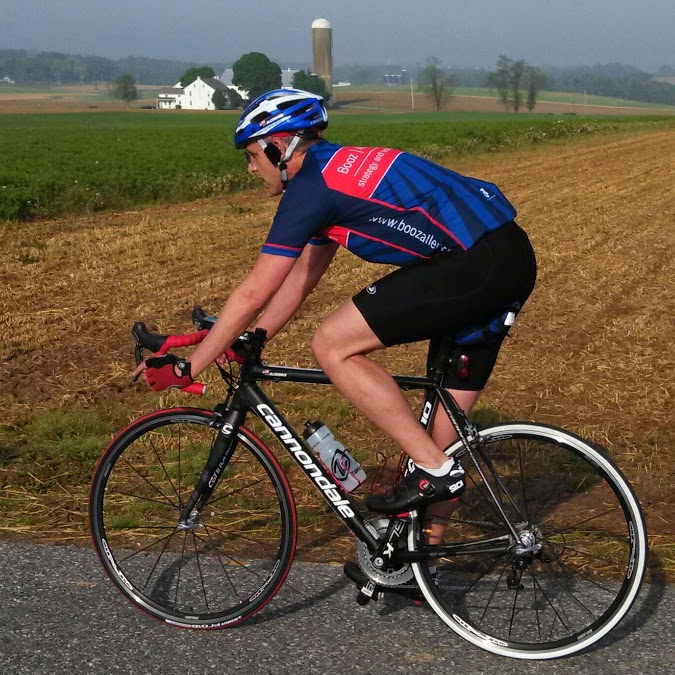
Riding my Cannondale CAAD10-3  with totally non-matching tires/wheels (I need more than one picture of me)
The bike is not a touring machine. It wants to be pushed and dawdling results in drift. This bicycle was meant to be ridden at a steady cadence (for me that means 80-100 RPM), with lots of out of the saddle climbs, lots of speed, and lots of  miles.

The Shimano Ultegra derailleurs and I have finally come to a truce (it been the noisiest drivetrain I have ever ridden). Now it shifts well and doesn't require frequent tuneups. Replacing the stock Cannondale shift cables with Jagwire cables helped.but unless it's dialed in to within a micron you will have chain rub, chain grind, and other shifty nonsense. It took me a solid 6 months to figure out. I'm sure the Campagnolo drivetrain spoiled me forever.

Eventually I took the plunge and upgraded the drivetrain to Shimano Dura Ace 7900 (Front and Rear Derailleur and chain). That and new wheels made the CAAD 10 a race-ready bike. The difference between Ultegra and Dura Ace should be slight. Well, not really. the DA stuff shifts more smoothly, grinds less, and looks cool. I'm spoiled,bu Camp awesome but DA is pretty perfect.

After 50 miles of rough pavement you will be more beat up on this bike than you will be on a high end carbon fiber or steel bike. It's a firm ride -- "plush" is not in the design spec -- and unless you are a supple rider you will feel it. I rarely ride over 50 miles, though I've ridden the CAAD10 on a few of hilly metric and full centuries. I finished, but was glad to be done. I'm sure the SuperSix EVO would be a better choice for true long distance fast riders.

Use the $3000 you will save (over a similarly equipped carbon ride) to buy decent wheels and tires and good cork handlebar tape.

I'm very happy with the Cannondale CAAD10-3. It's been a fine upgrade and a component machine. Kudos to Cannondale!


Fog Ride 2/21/2014

There was  a brief window this morning to get a ride in before intense work schedule and more intense thunderstorms rolled through. A quick check of accuweather and  then a moment outside confirms the prediction -- cold, foggy, damp. Oh well -- no way I'm spending an hour on the trainer when I can hear real asphalt humming under my wheels.

I don't even consider the GoPro today. First, the lens will be covered with water drops in seconds. Second, the video will be insanely dull -- an unending ribbon of pavement surrounded by varying shades of grey and white. No thanks.

It's easier to dress when it's very cold and dry -- lots of layers, ski gloves, neoprene booties, and thermal skull cap under the helmet make 15 F rides possible and reasonably safe. Moderately cold and damp (36 F) weather is a challenge. Over dress and the perspiration that would evaporate on drier days makes for clammy -- and inevitably cold -- riding. Under dress and it's just plain cold. I opted for one less layer than I wear on 20 degree days and rolled outside.

It was foggy -- and getting foggier. As the dew point spread gets closer, more water converts from vapor to liquid, making fog. It was slowly warming and that spread was coming down. At this rate the visibility would be a few hundred feet. Oh well, I'm not flying an airplane today, I'm wearing a Hi-Vis jersey, have a bright NiteRider Solas 2 Watt USB Tail Light, and a NiteRider Lumina 700 USB head light on full blink mode. It's after the normal morning rush so I should be OK.

The first mile is chilly but that's normal. Soon cadence, heart rate, breathing are normal and I make my way to the back roads. It's really getting foggy -- Soon I can barely see 30 yards ahead. The melting snow blanketing the fields fuse with the hazy light. I'm glad the roads are clear and the snow and ice have melted -- there's no way I would see an icy patch in time around a corner.

I follow a normal loop route, stopping and spending a bit more time at intersections looking for cars and trucks. About 20% are driving without lights on. It amazes me, really. Don't they understand that lights are as much about being seen as to see? Maybe not...

I don't push, ignore Strava KOMs, and enjoy a short 19 mile loop. By the time I'm home I'm drenched from the damp air. The bike rolls into the garage and onto the work stand and I go in and replace wet lycra for normal daytime attire.

Tomorrow is supposed to be clear, but windy. Clear? Above 30 F? I'll be outside...